

Spain’s Historic Wall: Breaking Down the Defensive System That’s Conceded Just One Goal All Tournament
Heading into the FIFA World Cup final, no team has been more defensively dominant than Spain. While fans often associate La Roja with elegant passing and relentless possession, this tournament has showcased another defining trait—an extraordinary defensive structure that has frustrated every opponent in its path.
Spain’s Historic Wall has become the biggest talking point of the competition after Spain reached the final having conceded just one goal throughout the tournament while recording a record number of clean sheets. Their semi-final victory over France once again highlighted a defensive system built on intelligent pressing, positional discipline, and collective teamwork rather than individual heroics.
With Lionel Messi and Argentina standing between Spain and another World Cup title, the biggest tactical battle may not be Spain’s attack—it may be whether Spain’s Historic Wall can stop one of football’s greatest ever players.
Table of Contents
Why Spain’s Defence Has Been So Effective
Most elite defensive teams rely on one exceptional centre-back or a world-class goalkeeper.
Spain’s success has come from something much bigger.
Their defensive strength begins before opponents even reach the penalty area.
Rather than defending deep for long periods, Spain defend proactively by controlling possession and pressing aggressively immediately after losing the ball.
This philosophy dramatically reduces the number of dangerous chances opponents can create.
It is one of the reasons Spain have consistently dominated matches throughout the tournament.
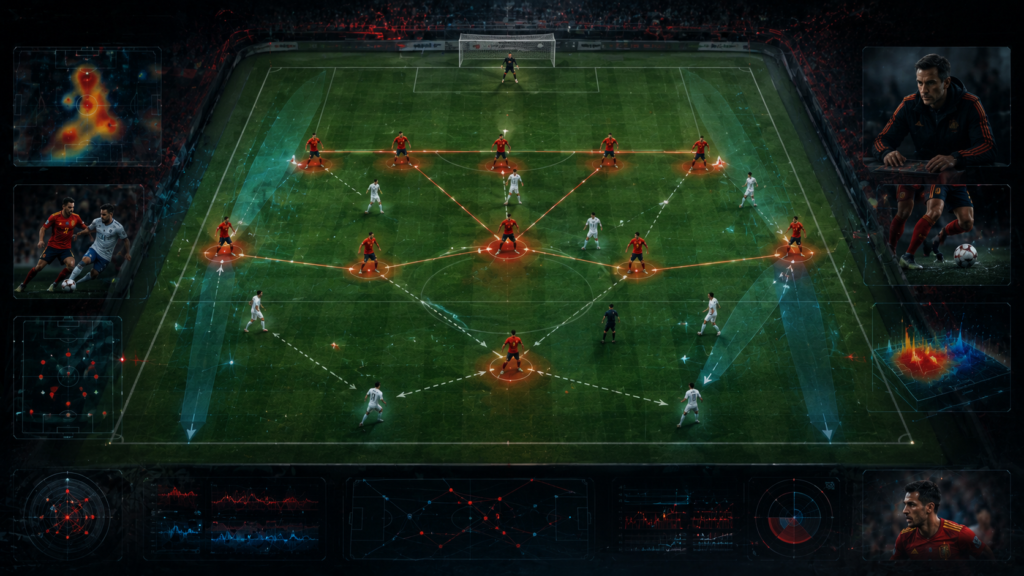
The High Press That Starts Everything
Spain’s defensive system begins with its forwards.
Whenever possession is lost, the nearest attacking players immediately press the ball carrier while teammates close passing lanes.
This coordinated movement forces opponents into rushed decisions.
Instead of allowing clean build-up play, Spain repeatedly force long passes or misplaced balls that are quickly recovered by the midfield.
Against France, this approach prevented the French midfield from establishing any rhythm.
Even experienced players struggled to progress possession through central areas.
Compact Defensive Lines
One of the defining characteristics of Spain’s Historic Wall is the incredibly short distance between each line of the team.
The forwards, midfielders, and defenders remain connected throughout the match.
This compact shape offers several advantages:
- Fewer passing lanes between midfield and defence.
- Easier pressing triggers.
- Better protection against counter-attacks.
- Quick support when possession changes.
Rather than chasing the ball individually, Spain defend as one coordinated unit.
This synchronization makes them extremely difficult to break down.
Intelligent Centre-Back Partnership
Spain’s central defenders have quietly enjoyed one of the best tournaments of any defensive pairing.
Rather than diving into tackles, they prioritize:
- Reading passing lanes.
- Delaying attacks.
- Maintaining defensive spacing.
- Winning aerial duels.
- Building play from the back.
Because the midfield protects the central areas so effectively, Spain’s defenders rarely find themselves exposed in one-on-one situations.
Good defending often looks simple—and Spain have made it appear effortless.
Full-Backs Who Attack Without Leaving Gaps
Modern full-backs are expected to contribute going forward.
Spain have balanced this responsibility perfectly.
Pedro Porro has been particularly impressive throughout the tournament, providing width in attack while recovering quickly during defensive transitions.
Whenever one full-back advances, the opposite side naturally tucks inside to maintain defensive balance.
This prevents opponents from exploiting wide counter-attacking spaces.
It is a subtle tactical detail that has made an enormous difference.
Midfield Protection
No defence succeeds without midfield support.
Spain’s midfield trio has consistently shielded the back line by:
- Winning second balls.
- Intercepting passes.
- Controlling possession.
- Slowing opposition transitions.
- Pressing immediately after losing the ball.
Instead of forcing defenders into emergency situations, the midfield solves many problems before danger develops.
This collective responsibility has been central to Spain’s Historic Wall throughout the tournament.
Goalkeeping Confidence
Although Spain’s defenders deserve enormous credit, their goalkeeper has also delivered calm, composed performances whenever called upon.
Elite goalkeepers do far more than make spectacular saves.
They organize defensive lines.
They claim crosses confidently.
They distribute accurately under pressure.
Most importantly, they give defenders confidence to maintain an aggressive defensive line.
Spain’s goalkeeper has excelled in every area.
Why France Couldn’t Break Spain Down
France entered the semi-final with enormous attacking quality.
Yet clear scoring opportunities remained extremely limited.
Spain succeeded because they controlled every phase of defending.
Build-Up Pressure
France struggled to progress the ball through midfield.
Spain’s pressing repeatedly forced long clearances.
Defensive Width
Spain’s defensive line shifted together across the pitch.
This eliminated the wide overloads France usually create.
Transition Defence
Every time possession changed, Spain immediately reorganized.
Counter-attacks rarely developed.
Instead of retreating desperately, Spain regained their defensive shape within seconds.
Possession as Defence
Perhaps Spain’s greatest defensive weapon isn’t tackling.
It’s keeping the ball.
Opponents simply cannot score without possession.
Spain regularly control matches by dominating the ball, reducing both physical pressure and defensive workload.
Can Spain Stop Lionel Messi?
The World Cup final presents Spain’s toughest challenge yet.
Stopping Lionel Messi requires far more than excellent defenders.
It demands complete tactical discipline.
Rather than assigning a strict man-marker, Spain are expected to defend collectively.
Key priorities will likely include:
- Limiting central passing lanes.
- Preventing quick combinations around the box.
- Compressing space between midfield and defence.
- Winning possession quickly after turnovers.
- Avoiding unnecessary fouls near dangerous areas.
Messi has repeatedly punished teams that focus solely on him.
Spain’s strength lies in maintaining their structure regardless of the opponent.
That philosophy will be tested like never before.
Why Spain’s Defensive Record Is Historic
Conceding just one goal in a World Cup tournament is remarkable.
Doing so while continuing to dominate possession and attack aggressively is even more impressive.
Rather than sacrificing entertainment for defensive stability, Spain have found the perfect balance.
Their record reflects:
- Outstanding coaching.
- Tactical intelligence.
- Team chemistry.
- Positional discipline.
- Consistent decision-making.
This isn’t simply a team defending well.
It’s an entire footballing identity working exactly as intended.
The Tactical Battle That Could Decide the Final
Many supporters expect goals in a World Cup final featuring Lionel Messi and Spain’s talented attackers.
Yet finals are often decided by much smaller details.
One defensive rotation.
One pressing trigger.
One interception.
One perfectly timed recovery run.
If Spain’s Historic Wall performs at the same level shown throughout the tournament, Argentina will need something extraordinary to break through.
Final Verdict
Spain have built the tournament’s most complete defensive system.
Their success hasn’t relied on luck or individual brilliance but on collective organization, relentless pressing, and positional excellence.
Whether facing elite attackers or under sustained pressure, Spain’s Historic Wall has remained remarkably consistent.
Now comes the ultimate examination.
If Spain can limit Lionel Messi and maintain the defensive standards they’ve shown all tournament, history awaits.
Regardless of the final result, this Spanish defence has already established itself as one of the greatest collective defensive performances ever witnessed on football’s biggest stage.
Why has Spain conceded so few goals?
Spain defend collectively through coordinated pressing, compact defensive lines, excellent possession control, and disciplined positioning.
What makes Spain’s historic wall different?
Instead of relying solely on defenders, every player contributes to pressing, recovering possession, and protecting central spaces.
Who has impressed most in Spain’s defence?
Pedro Porro has stood out with his balance between attacking contributions and defensive recovery, while the centre-back partnership and midfield have been consistently excellent.
Can Spain stop Lionel Messi?
Spain’s best chance lies in maintaining their collective defensive structure rather than focusing on individual man-marking.